
Restorative Dentistry · Murrieta, CA
Restorative Dentistry in Murrieta: Which Repair Your Tooth Actually Needs
Filling, crown, root canal, implant, bridge, or denture. One page on how I decide between them, and what each one costs before you sit down.
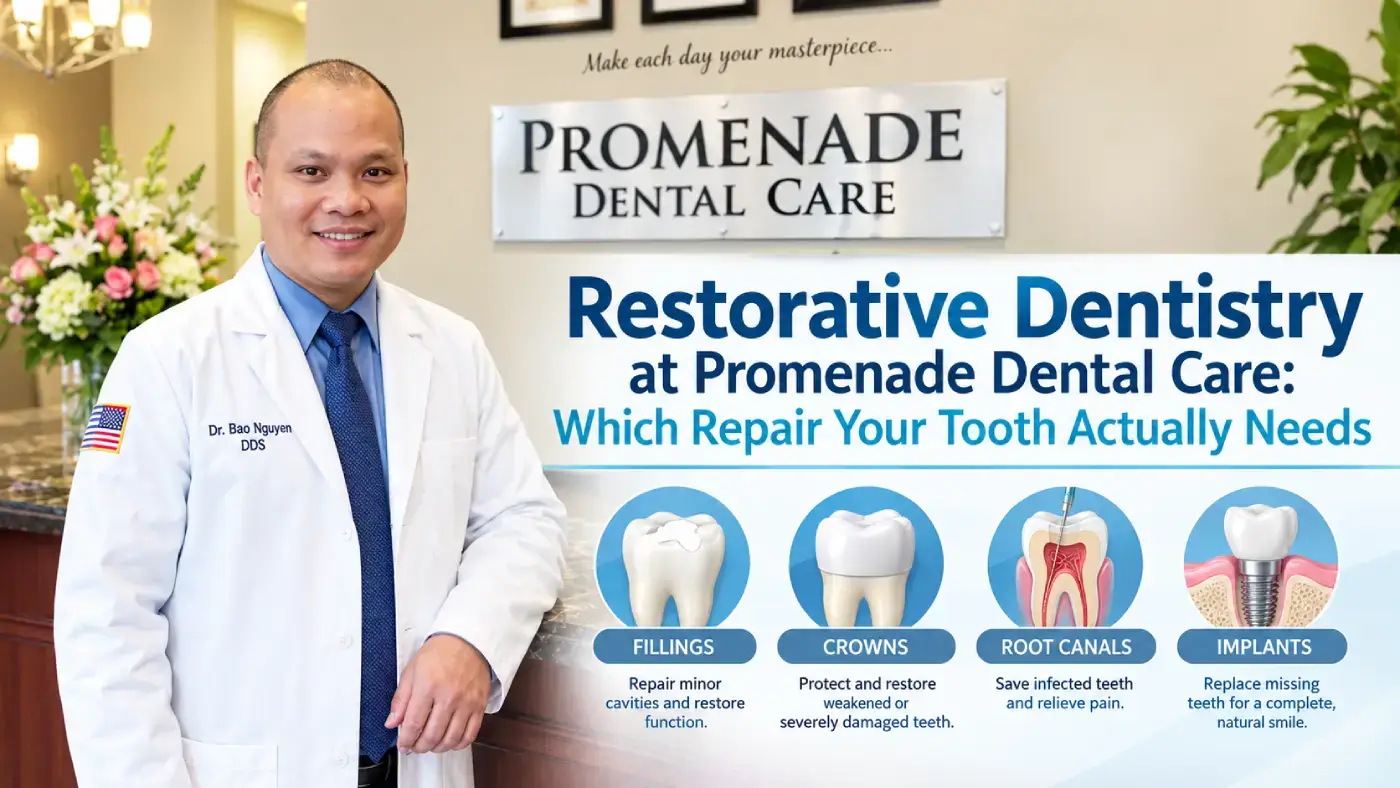
I am Dr. Bao Nguyen. Restorative dentistry is the part of my job that has nothing to do with how a smile looks and everything to do with whether a tooth can keep doing its work. It is the repair side of the practice: rebuilding a tooth that decay or a crack has damaged, and replacing one that is gone. Most people arrive here with a diagnosis someone else gave them and a number they do not trust. This page walks the same ladder I walk in my head at every exam, from the smallest repair that will hold to the point where a tooth is not worth saving, and then through the three ways to replace one. Every treatment has its own page on this site. This page exists to help you tell them apart.
UCLA School of Dentistry10 years, U.S. Navy Dental CorpsDate Street, Murrieta, since 2010
The Definition
What Restorative Dentistry Covers
Restorative dentistry is the repair and replacement of teeth. The Cleveland Clinic's definition is as plain as mine: it repairs or replaces damaged or missing teeth so you can chew, speak, and keep the rest of your mouth healthy. It is what a general dentist spends most of the day doing, and it is the reason a dental office has a drill in it.
What it is not is cosmetic. Cosmetic work changes how healthy teeth look. Restorative work fixes teeth that are not healthy, and any improvement in appearance is a by-product. That distinction sounds academic until the insurance statement arrives, so I come back to it further down.
- Repairs a damaged tooth
- Tooth-colored fillings, ceramic inlays and onlays, same-day CEREC crowns, root canal treatment.
- Replaces a missing tooth
- Dental implants, fixed bridges, full and partial dentures, implant-supported snap-on dentures.
- Where it happens
- All of it in one office on Date Street in Murrieta, by one dentist, from the first X-ray to the final crown.
- Starting point
- A $20 exam with digital X-rays, and a written quote for every option before anything is scheduled.
- Insurance
- Restorative work is the category dental plans were built to pay for. Cosmetic work usually is not.
When the Tooth Is Still There
A Damaged Tooth: The Repair Ladder
When a tooth is cracked, decayed, or worn, there are only four rungs, and the tooth's condition decides which one it lands on, not my preference. I always reach for the lowest rung that will hold, because every step up removes more of the tooth and costs more money.
1A cavity caught early: a filling
The decay is cleaned out and the space is rebuilt with tooth-colored composite, in one visit, with the tooth numb. It is the least expensive repair in dentistry, and finding cavities at this stage is the whole point of the X-rays at a routine exam. How I do fillings.
2A big cavity, a cracked cusp, or a failed filling: a crown, inlay, or onlay
When more of the tooth is missing than remains, a filling has nothing to hold on to. A crown covers the whole tooth; an inlay or onlay rebuilds part of it. Both are milled here on the CEREC and bonded the same morning, so there is no temporary and no second visit. Same-day crowns.
3Decay or a crack that reached the nerve: a root canal, then a crown
Once bacteria are inside the tooth, no filling fixes that. The infected pulp is cleaned out and sealed, and a back tooth almost always gets a crown afterward, because a root-canal tooth is brittle without one. Root canal treatment.
4Not enough tooth left to save: extraction, then replacement
Sometimes the honest answer is that the tooth is done. I take it out cleanly, let the site heal, and we move on to the next section of this page. Tooth extraction.
When the Tooth Is Gone
A Missing Tooth: Three Ways to Replace It
A gap does more than look like a gap. The teeth on either side lean into it, the tooth above or below drifts toward it, and the bone underneath starts to shrink within the first year. Replacing a tooth is about protecting the ones around it as much as filling the space. Three options, in the order patients usually ask about them:
The implant-versus-bridge question deserves more than a paragraph, so I gave it its own page: bridge vs. implant. And if the real question is what makes sense at this stage of life, that has a page too: tooth replacement for seniors.
The Whole Menu on One Table
Every Restorative Option, Side by Side
These are the figures I put in writing at this office and the ranges I quote patients for how long each repair lasts. The insurance column is how most PPO plans file the claim, which decides what share they pay.
| Option | Best for | Visits | Typical lifespan | Insurance category | The number |
|---|---|---|---|---|---|
| Composite filling | Small to mid-size cavity | One | 7 to 15 years, longer on small fillings | Basic restorative, the best-paid category after preventive care | Written quote after the $20 exam |
| Same-day CEREC crown, inlay, or onlay | Large cavity, cracked or worn tooth, root-canal tooth | One, about two hours | 10 to 20 years or more | Major restorative | Crown from $1,054 cash, in writing before I start |
| Root canal | Infected or dying nerve | One to two, plus the crown | Decades, when the tooth is crowned afterward | Basic or major, depending on the plan | Written quote; sedation available |
| Dental implant | One or more missing teeth with healthy bone | Three to four, over 3 to 6 months | Post can last for life; crown 15 to 25 years | Major restorative | All three parts priced in writing after the exam and CT scan |
| Fixed bridge | One to three missing teeth with strong neighbors | Two, about three weeks apart | 10 to 15 years | Major restorative; most PPO plans pay about 50% after the deductible | Written quote, with the implant alternative beside it |
| Full or partial denture | Many or all teeth missing | Several fittings | 5 to 8 years between relines and remakes | Major restorative | Written quote; immediate and snap-on versions priced separately |
Lifespans assume a tooth that gets brushed, flossed, and checked twice a year. A grinder who skips cleanings shortens every row on this table, which is why an occlusal guard sometimes shows up on a restorative treatment plan.
Sequencing
Why the Order of the Work Matters
Restorative work is sequenced, and the sequence is where money gets wasted when a mouth is being handled by four different offices. A few rules I do not break:
Gum disease first. A crown on a tooth with active periodontal disease is a crown on a sinking foundation. Bleeding, receding gums get treated before I restore anything above them.
Root canal before the crown, not after. If a tooth needs both, the canal is done first and the crown seals it. Crowning first and drilling through the crown later ruins a crown that was paid for.
Extraction, then healing, then implant. An implant goes into settled bone. When a tooth is removed we usually let the site heal, and if the bone is thin, especially under an upper back tooth, a sinus lift or graft comes first and adds three to four months to the timeline.
One chart, one dentist. Because I do the extraction, the graft, the implant, the crown, and the denture myself, nothing gets lost between offices and nobody re-bills a step. The plan is written once, at the beginning.
The Question Behind the Insurance Denial
Restorative or Cosmetic? Why the Label Matters
Patients ask me this more than any other definitional question, usually right after a plan has denied something. The rule is short. If the tooth is damaged, decayed, missing, or failing, the work to fix it is restorative. If the tooth is healthy and you want it to look different, the work is cosmetic.
Where it blurs is a front tooth. A ceramic crown on a broken front tooth is restorative, and it will also be the best-looking tooth in your mouth afterward. The Cleveland Clinic calls that overlap aesthetic restorative dentistry, and the American Dental Association's own crown guidance lists both jobs for the same restoration: strengthening a tooth that can no longer hold a filling and covering one that is badly shaped. What decides the claim is the reason for the work, which is why my notes and X-rays document the crack, the decay, or the failed filling. A veneer on an intact tooth is cosmetic, and I will tell you that before you book, not after.
Money, Plainly
What Restorative Dentistry Costs in Murrieta
I do not quote a repair over the phone, because a guess helps nobody. What I do is put every option in writing after a $20 exam with digital X-rays, including the option of doing nothing for now when that is defensible. The same-day crown starts at $1,054 cash, and that number is on this site because it is real. Everything else depends on the tooth, so it depends on the exam.
Promenade Dental Care accepts all PPO plans and is in-network with Delta Dental PPO, Cigna, MetLife, Guardian, Aetna, and United Concordia. Restorative work is what those plans are designed to pay for. Fillings usually sit in the basic category with the highest payout. Crowns, bridges, implants, and dentures sit in major, where most plans pay about half after the deductible and every dollar counts toward the annual maximum. My front desk verifies your specific plan before the visit, so the written quote already has your share on it. Uninsured patients get flat cash pricing, and CareCredit financing with up to six months no interest is available for qualified applicants.
One more thing, because it shapes every recommendation on this page: I own the practice. Nobody hands me a monthly production goal. When a filling will hold, you get a filling, and the ladder above is the order I actually use, not a menu arranged by price.
Who Wrote This
Reviewed by Dr. Bao Nguyen, DDS
I graduated from the UCLA School of Dentistry and spent ten years in the U.S. Navy Dental Corps, including an AEGD residency at Camp Pendleton where restorative dentistry was the daily work: fillings, crowns, root canals, and replacing teeth for Marines who could not wait two weeks for a lab across town. The CEREC in this office is a direct result of that. I got used to finishing a tooth in one sitting and never wanted to go back to temporaries.
I have practiced on Date Street in Murrieta since 2010. Most of what I do all day is on this page, and the part I am proudest of is the number of teeth I have talked people into keeping.
Each Treatment, on Its Own Page
The Restorative Treatments at Promenade Dental Care
Tooth-Colored Fillings
Composite, ceramic, and the rare case for amalgam. Materials, cost, and how long each lasts.
Same-Day CEREC Crowns
Scanned, milled, and bonded in about two hours. From $1,054 cash, in writing.
Root Canal Treatment
The signs a nerve is dying, what the procedure involves, and why the crown matters.
Dental Implants
Candidacy, the three-part price, the timeline, and computer-guided placement.
Dental Bridges
Traditional and implant-supported bridges, and who is a better fit for one than an implant.
Dentures
Full, partial, immediate, and snap-on implant dentures, and how each one compares.
Tooth Replacement for Seniors
What makes sense later in life, and what does not.
From Our Google Reviews
What Restorative Patients Say
“I had a crown and root canal done with zero pain. I was able to get in the same day. Hands down the best dental experience I’ve had — zero pain, zero wait time. Pricing is always upfront and affordable.”
— Alicia A. · Google Review
“Skilled, friendly, and includes you every step of the way. Love that I could do a full cap replacement in one visit. Thank you Dr. Bao, you’re my new go-to man for dental work.”
— Philip C. · Google Review
“Dr. Nguyen does a great job. He is always on time and very honest. Never has you do unnecessary treatments just to make extra money. I love that he is a solo practitioner and runs his own shop.”
— Tom H. · Google Review
“The dentist / Owner is informative and concerned with the patient and their needs. He tells the truth. No sells pitch, just the right procedure advised with the patient as his prime concern.”
— Larry H. · Google Review
Restorative Dentistry FAQs
Questions Patients Ask Before Choosing a Repair
What is restorative dentistry?
Restorative dentistry repairs damaged teeth and replaces missing ones. Fillings, crowns, inlays and onlays, root canals, implants, bridges, and dentures are all restorative. The goal is function and health: a tooth that chews, does not hurt, and does not put the teeth around it at risk.
What is the difference between restorative and cosmetic dentistry?
Restorative work fixes a tooth that is damaged, decayed, missing, or failing. Cosmetic work changes how a healthy tooth looks. A crown on a cracked molar is restorative; a veneer on an intact front tooth is cosmetic. The reason for the treatment, not the material, decides the label, and it also decides whether insurance pays.
Does dental insurance cover restorative dentistry?
Usually, yes. Fillings are normally filed as basic restorative, the best-paid category after cleanings and exams. Crowns, bridges, implants, and dentures are filed as major restorative, where most PPO plans pay about half after the deductible, up to the annual maximum. Promenade Dental Care accepts all PPO plans and verifies your specific coverage before the visit.
How do you decide between a filling and a crown?
By how much healthy tooth is left. A filling needs solid walls to bond to. When decay or a crack has taken more of the tooth than remains, or a cusp has broken off, a filling will fail and a crown or onlay is the repair that holds. I show you the X-ray and the tooth on screen so you can see the same thing I see.
Do I need a crown after a root canal?
On a back tooth, almost always. A root-canal tooth has lost its blood supply and a large part of its structure, and molars take heavy chewing force. Without a crown, the tooth is likely to crack. On a front tooth with most of its structure intact, a filling is sometimes enough, and I will tell you when that is the case.
Can a broken tooth be repaired in one visit?
Most of the time. Fillings are always one visit. Crowns, inlays, and onlays are designed and milled in this office on the CEREC and bonded the same day, usually in about two hours, so there is no temporary and no second appointment. Root canals are one or two visits, and the crown can often be done at the same visit as the canal.
Should I get an implant or a bridge for a missing tooth?
If the bone is healthy and you can wait a few months, an implant is usually the better long-term choice because it preserves the bone and leaves the neighboring teeth alone. A bridge makes sense when the teeth on either side already need crowns, when surgery is off the table, or when cost today matters more than cost over twenty years. The bridge-versus-implant page on this site lays out both cases in full.
How long do dental restorations last?
Composite fillings typically last 7 to 15 years, ceramic crowns 10 to 20 years or more, bridges 10 to 15 years, and dentures 5 to 8 years between relines and remakes. An implant post can last for life, with the crown on top lasting 15 to 25 years. Home care, grinding, and regular cleanings move every one of those numbers up or down.
What happens if I put off a restorative treatment?
The repair gets bigger and more expensive. A small cavity becomes a crown, a crown case becomes a root canal, and a root canal left untreated becomes an extraction and a replacement. The damage only moves in one direction, which is why I would rather see a tooth for a $20 exam now than for an emergency later.
Is restorative dental work painful?
The tooth is fully numb for every procedure on this page, and nitrous oxide or oral sedation is available for anyone who is anxious. Afterward, a filling or crown may be mildly sensitive for a few days; a root canal or extraction is sore for two or three days and managed with over-the-counter medication. Most patients tell me the anticipation was worse than the visit.
Can all of my restorative work be done in one office?
Yes. Fillings, same-day crowns, root canals, extractions, bone grafting, sinus lifts, implant placement, implant crowns, bridges, and dentures are all done by Dr. Bao Nguyen at Promenade Dental Care on Date Street in Murrieta. One dentist and one chart from the exam to the final restoration, with the whole plan priced in writing at the start.
Not Sure Which Repair Your Tooth Needs?
Twenty dollars and one set of digital X-rays gets you a written answer with every option on it.
(951) 412-0127 Call Promenade Dental Care